Be Your Own CEO
For decades you could read a manager's rank off the number of assistants in the hallway. The executive floor managed exceptions; everyone else managed errands. This month the assistant arrived for everyone. The judgment about what to hand it did not.

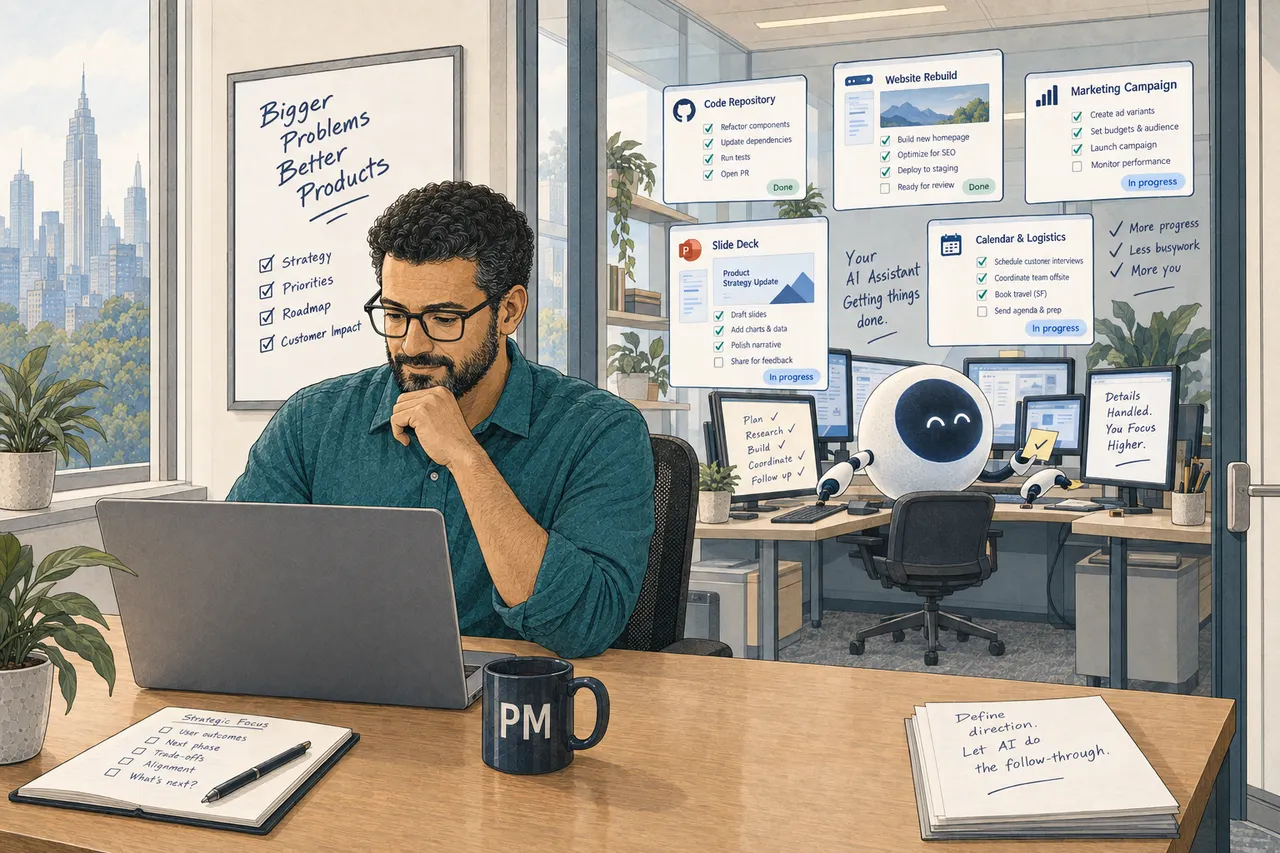
In one company I worked for you could read a manager's rank off the hallway. One assistant shared between four directors. One assistant per vice president, in the adjacent office. Above that, a small team: a chief of staff, an admin, someone who did nothing but travel and calendars. Nobody printed the org chart. You could count it in desks.
That arrangement was never only about status, though it was about status. It bought the leadership layer the one thing the rest of us did not have: a working day made of exceptions and direction. The vice president did not book the room, reformat the deck, chase the signature, or spend forty minutes finding out why the expense report bounced. Someone did that, and the someone was a person, which is why it worked. Every attempt to replace that person with software, and there have been decades of attempts, produced a scheduling tool, a template, a chatbot that could tell you the weather, and a calendar that still needed a human to fight with. None of it came close to an actual assistant, because an assistant's job is not any single task. It is absorbing the whole category of tasks that are beneath the attention of the person they serve, including the ones nobody wrote down.
For everyone below the executive floor, the arrangement was the opposite. You were your own assistant. The day was made of the small work, and the direction-setting happened in whatever was left.
Something changed in the last few weeks, and I want to describe it plainly, because it is the first time in my career the executive arrangement has shown up at my own desk.
What arrived
Three releases in a month are the reason. OpenAI shipped GPT-6 Astra in early September as its flagship reasoning model for long multi-step work across code, browser, and computer use. And yesterday, at DevDay, OpenAI launched Dots: a personal agent built on Astra, with its own cloud computer, connections to several thousand applications, and a design brief that amounts to pursue the user's goals continuously in the background with minimal oversight. Meta's own personal agent, Muse, had arrived weeks earlier, and at Connect it got a body: the Muse Charm, a pocket-watch-sized device with a screen, a fingerprint sensor, and 5G, so you can talk to your agent without unlocking a phone or opening an app. It ships in December. Apple, the same month, shipped the rebuilt Siri with its own app, personal-context search across your mail and messages, and on-device orchestration. The market for the executive's assistant, sold by the seat to everyone, is suddenly real and contested, and the contestants do not agree on what an assistant is.
I have been using a Dot for a day. That is the honest span of the evidence, and I will come back to what it does not yet prove. But the day was unlike anything I have had from a model before, and the difference is not intelligence. Every model I have used for two years was smart. The difference is the direction of delegation.
The assistant that asks for work
That disagreement is the whole story, and the new Siri is the clearest way to see it. I have had it for two weeks and I have not found a task it does for me that I would have paid an assistant to do. It finds the restaurant a friend mentioned, it adds the meeting, it answers. It is a better search box over my own life, bounded by my phone and built to stay there, and that boundary is a design choice Apple made on purpose. The Dot has its own computer. It works across the four thousand applications my life actually runs on, and it keeps working when I put the phone down. One of these is an assistant in the sense the executive floor meant. The other is a very good concierge. The difference is not the model. It is whether the thing is allowed to act.
Every AI tool I have used until now, however capable, ended its turn by handing me a list. Here are the steps. You should do this next. Would you like me to draft the email for you to send. The model did the thinking and I did the errands, which is exactly backwards from how an executive's office runs. The Dot inverts it. It finishes a task and asks what else it can take. It notices a loose end and offers to close it. It behaves, in other words, like the person in the adjacent office, whose first question in the morning is what can I get off your plate.
Here is what it got off mine, in roughly twenty-four hours.
I handed it a coding project I have been running for months with a coding agent and an architect agent, and asked it to act as the program manager. It cleaned the repository, rebuilt the documentation so a stranger could follow it, and then kept the two other agents in working mode, assigning, reviewing, and re-assigning, until the backlog was closed. I did not write a ticket.
I asked for a new personal website. It scraped every page and image off the old one, rebuilt the site, pushed it to production, and moved the domain to the new host. I did not click a mouse once from the request to the live site.
It built three presentations for an enablement series I teach on how the product management role is changing, working from my own articles and the previous decks, the way I described in "Where the Time Came From," except that this time I was not running the loop. It was.
And it designed a promotional campaign for one of my books, built it in Amazon Ads, and told me when it was running.
None of those is a demo task. Each is the kind of multi-day, multi-tool, cross-system chore that used to sit in my backlog for a month because it was never the most important thing and never small enough to do between meetings. It is precisely the work the executive floor never did, and it is precisely the work the rest of us never got to stop doing.
What this is, and what it is not
Be careful with the phrase I used in the title. Being your own CEO is not a promotion. Nobody gave you a budget or a board. What changed is the composition of the day: the proportion that is exception management and direction, versus the proportion that is the errand you could describe in a sentence but had to perform with your hands. For most of a career that ratio was fixed by your grade. It is now fixed by how well you can delegate, and delegation is a skill the lower floors were never taught, because they never had anyone to delegate to.
It is also not autonomy without supervision, and I want to say this while the day is still fresh, because everything I have written for a year argues the opposite of the easy version. The vice president's assistant earned trust over years, and the vice president still read the important letters before they went out. A Dot that runs continuously in the background with minimal oversight is a Dot you are accountable for, and the model underneath it, Astra, uses a reasoning technique that obscures part of its own chain of thought, which means the question "why did it do that" is harder to answer than it was with the last generation, not easier. The campaign is running on Amazon under my name. The domain moved under my account. I approved both, and I read what it did before I did. The executive who stopped reading the letters was always the one who ended up in the newspaper.
So the revolution is real and it is narrower than the headline. The assistant has arrived for everyone. The judgment about what to hand it, and what to check when it comes back, did not arrive with it. That part is still the job, and it is now most of the job.
The desk count
I keep thinking about that hallway. The count of adjacent offices was a map of whose time the company had decided was worth protecting. It was never a map of whose time was actually most valuable, because the organization had no way to know that, so it used rank as a proxy and bought assistants for the top of the chart.
That proxy just broke. The assistant costs the same for the director and the analyst, and it does not care about the org chart. Which means the first question every manager will be asked in the next review cycle is not whether they have an assistant. It is what they did with the day it gave back.
This article is part of an ongoing series on AI product design, healthcare data, and the human side of technology adoption.


