Your AI Agent Skipped Every Hiring Gate. You Made Yourself Its Manager Anyway.
We run every new hire through recruiting, references, a probationary period, and a 90-day review. Then we deploy an AI agent into the same workflow and skip every gate. The technology question is settled. The HR question has not been asked.

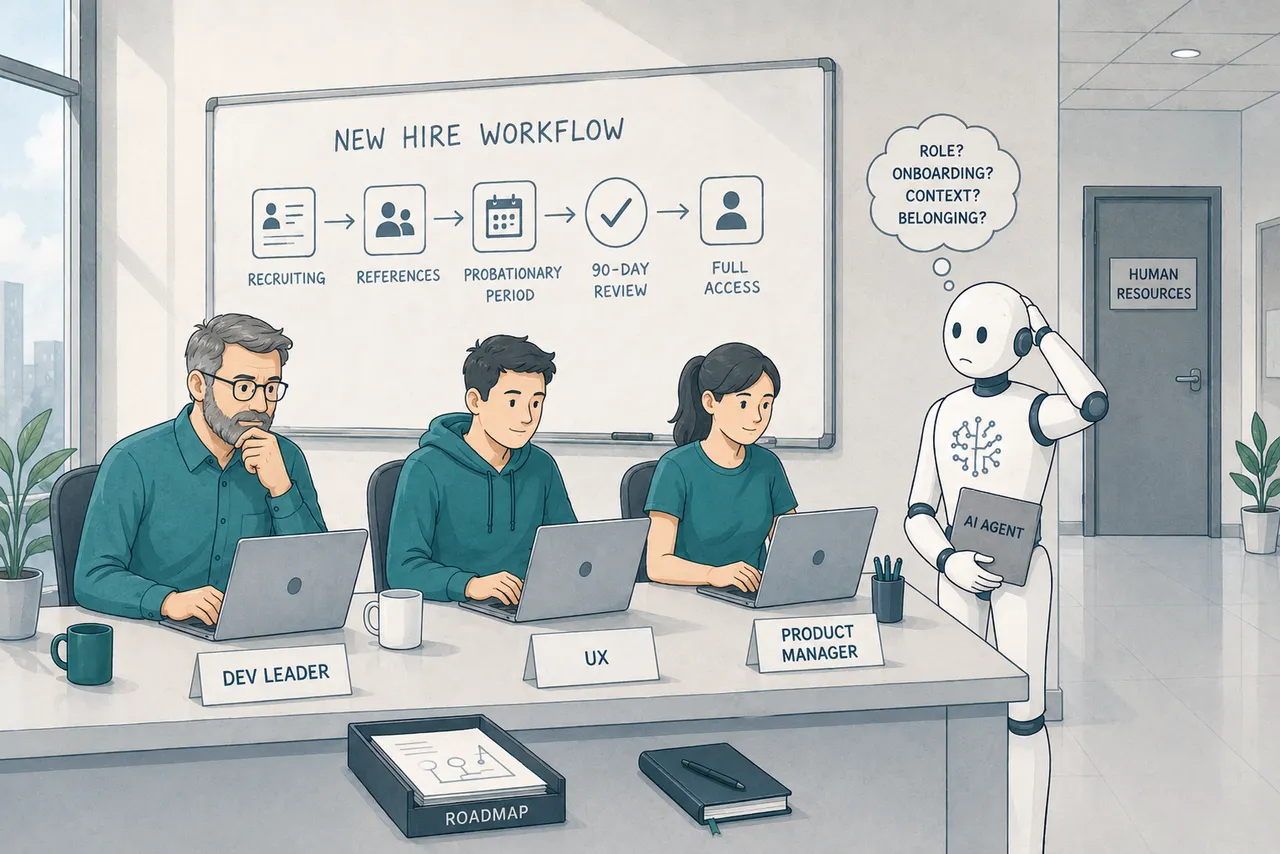
The conversation about AI in healthcare and enterprise has settled on a comfortable shape. "Can AI do this work?" is closed. "How do we integrate it?" is open. Everyone agrees integration is about workflows, governance, and culture. Everyone is wrong about which department owns the problem.
A newly licensed MD is sometimes called a "license to kill." Formally authorized to do anything. Real-world experience close to nothing.
I worked as an EMT physician at a cardiac center shortly after my internship ended. The center had a team of cardiac nurses, most of them with twenty years on the job. Subscribers transmitted their ECGs over the phone. The nurses read them, made decisions, dispatched ambulances. I was the MD on shift. On paper, the supervisor. In practice, I was learning from them while pretending to supervise.
What I learned, fast, was who to trust without checking. Who to validate twice. Who I wanted on the ambulance with me. Who I could hand a code to if it came to that.
None of that was on their credentials. It was how they behaved under pressure. Whether they admitted uncertainty. Whether they said "I'm not sure, take a look" instead of presenting every reading as certain. Whether their tone in a chaotic moment got tighter or looser. Whether they communicated when things went wrong, or covered.
Twenty years of experience meant something. But on the actual shift, what mattered was the qualities HR tries to approximate in an interview and never fully can. Trust. Calibration. Composure. Honesty about what you do not know.
Now consider what we have just done in every enterprise that deployed an AI agent last quarter. We added a new team member to that ride. Nobody interviewed them for any of it.
Three pieces have been circulating this week. Harvard published in Science showing OpenAI's o1-preview diagnosed real ED cases more accurately than attending physicians at the earliest stage of care. Mayo's REDMOD model flagged seventy-three percent of pre-diagnostic pancreatic cancers on CT scans that radiologists had already read as normal. Boston Consulting Group (BCG), one of the global strategy consultancies enterprises rely on for digital transformation advice, argued healthcare is hitting a structural breaking point: too many AI pilots, not enough scaled deployments.
The takeaway, repeated across LinkedIn, is some version of: "The technology works. The challenge is organizational change. We need governance, workflow redesign, and clear rules for where AI advises, acts, or escalates."
This is correct. It is also one altitude too high to be useful.
Because here is the part nobody is saying out loud. We are adding new actors to teams. We are letting them take action in workflows. We are asking managers to supervise them. And we are doing it without putting them through any of the gates we require for the nurse on the next shift.
No interview. No reference check. No probationary period. No question about uncertainty.
The technology question is settled. The HR question has not been asked.
The reframe nobody is comfortable with
The org chart does not care about consciousness. It cares about who acts.
If an agent acts in your workflow, it is structurally a team member. It generates output. It makes decisions inside an authority boundary. It interfaces with humans who treat its output as input to their own work. That is a team. There is no other word for it.
Some readers will call this anthropomorphism. Treating a piece of software as if it had agency, judgment, or personhood. The objection is fair, and worth naming directly. I am not claiming the agent thinks the way a nurse thinks. I am claiming the org chart does not know the difference. The supervisory infrastructure that exists for an actor exists because an actor takes action, not because an actor is conscious. Removing the consciousness does not remove the action. It just removes our excuse for skipping the infrastructure.
We refuse to call it a team member because calling it that would force uncomfortable questions about who hired them, on what terms, under what supervisory infrastructure.
Some readers will push back further. AI agents are not team members, they are tools, APIs, vendor products. Fine. Call them what you actually have: persistent contractors with no statement of work, no acceptance criteria, no performance bond, no termination clause. The HR question becomes a procurement question. Your AI agents skipped that infrastructure too.
Either way, employee or contractor, the same gap. An actor in the workflow without the institutional machinery that exists precisely to make new actors safe to add.
What HR actually does, and why none of it exists for AI
I have sat through enough hiring processes to know what they are designed to catch. References. Probationary period. Performance review. Those three alone do most of the work. The rest of the HR machinery is documentation.
The point of the machinery is not to be thorough. It is to refuse to add an actor to the workflow until somebody who is accountable has looked at them and decided.
The AI agent your team deployed last quarter went through none of it. Someone watched the vendor demo. Someone got procurement approval. Someone integrated the API. The thing you required for the receptionist, you did not require for the agent that drafts clinical documentation. The thing you required for the junior engineer, you did not require for the agent that proposes code changes.
The justification, when you press on it, is "but it's not really a person." True. And not the point. The supervisory infrastructure required for a person who acts in your workflow is required for any actor who runs your workflow. Removing the personhood does not remove the need. It just removes the paperwork.
One of the gaps is structurally worse than the others. Culture fit, on the standard HR list, is the evaluation that catches misalignment between an actor's default behaviors and the organization's norms before the actor has authority. For human hires, defaults are local. The candidate developed them through prior employers, education, lived experience, and the customer organization evaluates fit against its own culture during the interview. The defaults can be observed, probed, and rejected.
For AI agents, defaults are not local. They are baked in upstream by the model provider during training. When an agent encounters an ambiguous instruction, what does it default to? Conservatism or speed? Escalation or autonomy? Caveats or confidence? Those defaults are determined by a company you do not work at, by people you have never met, optimizing for goals that may or may not align with your culture. A pharmaceutical company that prizes conservative, escalation-heavy clinical decision-making has deployed agents whose defaults were tuned by an AI lab whose culture prizes speed and breadth. Nobody checked whether the cultures match. Nobody could have.
This is not a metaphor. It is a structural property of foundation-model-based agents: their cultural defaults are non-local. Culture fit, the one HR mechanism that exists specifically to catch this kind of misalignment, cannot be performed by the customer organization at all. Not because they forgot. Because the evaluation surface is not available to them.
The specifics matter, and they are more than one paragraph can hold. Confidence calibration, the nurse who says "I'm not sure, take a look" versus the one who presents every reading as certain, is one of the least solved problems in production AI. Reading the room, the skill that distinguishes a thoughtful colleague from a dangerous one, is something agents do not have. In healthcare especially, that skill is the job. Talking to a healthy twenty-year-old at an annual visit is not the same as talking to an elderly woman who just learned she has cancer. Talking to a patient who arrived alone is not the same as talking to one whose family is in the room. Same diagnosis, same clinical facts, completely different register required. Different models have different personalities, observable to anyone who has worked with them, and those personalities affect team fit. None of this is being measured before deployment. Each of these is worth its own treatment. They are coming.
What the BCG report misses
BCG, in every consulting deck this quarter, says AI pilots fail to scale because organizations cannot redesign workflows fast enough. Recommendation: more workflow redesign, better governance, stronger change management.
Right and incomplete. The pilots fail to scale because the infrastructure for managing a new actor is missing. "Workflow redesign" is the part the consultants have language for. In practice it usually means decomposing how work flows between humans and systems, deciding which steps the AI handles, which the human handles, and where the handoffs happen. That is real work and it has to happen. It is also the part of the conversation that quietly tends to optimize humans out of the workflow rather than into a better version of it. HR's job has always included making sure "redesign" is not a synonym for "reduction in force." That is the part of the redesign conversation that does not happen, because the people doing the redesign are not HR. The smaller and more immediate problem this piece is taking up is that "workflow redesign" has language at all. The personnel-management part has none yet, because the personnel categories were built for humans, and nobody has done the work of translating them.
This is not organizational laziness. Every other actor has an existing infrastructure. New employee, HR. New contractor, procurement. New clinical device, biomed and credentialing. The AI agent fits none of these cleanly. We treat it as a software integration because that is the only category we have. The misfit is what makes the problem invisible until it surfaces as a supervision failure.
There is also a downstream consequence worth flagging. Once we deploy these agents without the gates, the humans supervising them face a different problem: validating output produced faster than humans can read, while the underlying human skills required for validation gradually atrophy. That is its own argument, and it gets its own piece.
What this changes
The question to ask before any AI deployment is not "what workflow does this fit into?" It is "what would HR require for a human in this role, and where is our AI equivalent?" If the answer to the second is "we do not have one," you do not have a deployment plan. You have an unsupervised contractor with API access.
The supervision-of-smarter-reports literature is the right place to look for vocabulary. Not the AI safety literature, mostly written by people who have never managed a team. Not the governance literature, mostly written by people who manage committees rather than reports. The HR literature on delegation and trust calibration is the closest thing the field has to a working model. Use it.
None of this is invented. All of this exists.
The mirror part
If you are a product manager, an engineering leader, or a clinical operations leader who has deployed an AI agent in the last twelve months, ask yourself the questions you would have asked about any human you hired into the same role.
Did you check references on this agent? Did you put it through a probationary period with explicit success criteria? Did you assign a manager accountable for its performance? Did you build the equivalent of a 90-day review, a corrective action process, an exit process?
If the answer to most is no, you did not deploy an AI agent. You hired a contractor with no oversight infrastructure and gave them a desk in the middle of your team. The contractor is faster, smarter, and more confident than the humans around them. The humans are accountable for the contractor's work. The contractor cannot be fired, demoted, or coached. The contractor will be there tomorrow whether you supervised them today or not.
If I had hired this contractor at the cardiac center, I would not have wanted them on the ambulance.
The technology question is settled. AI can do the work. Whether your organization can build the supervisory structure required to let it do the work safely is a different question. It is not a workflow question. It is a personnel question. And the people who own personnel questions are not in the room when the deployment decision is made.
That is the problem. Until that changes, no amount of governance committees, evaluation rubrics, or workflow redesign will close the gap. We are not missing the technology. We are missing the category, the institutional machinery that exists for every other kind of actor an organization adds to its workflows. We are missing it not because we forgot, but because nobody built the category yet. That is what needs to change.
This is the first of three pieces on AI agents and the personnel infrastructure that does not exist for them yet. The next two will go deeper on the parts gestured at here: the personality and team-fit dimension that enterprise hiring has measured for decades and nobody is measuring for agents, and the validator-of-the-validator problem that emerges when humans review AI output faster than they can write it themselves.


