What CEOs Need to Know to Win the AI Bloodbath
Most CEOs are optimizing for when the agent ships. The question that matters is what the customer experiences during the rollback. Five things the current agentic AI plan is missing, and the four questions the CEO should be asking before any agent ships.

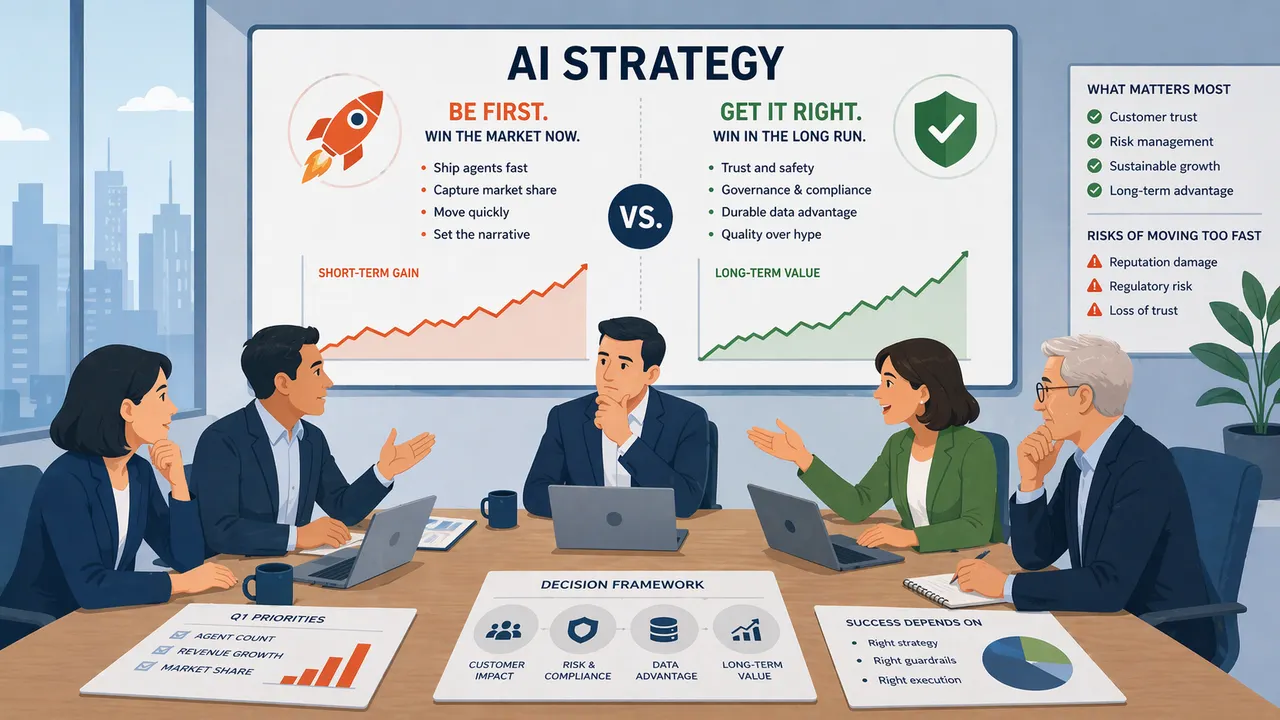
Five things most CEO decks on agentic AI are missing, and the four-question pre-launch review that closes the gap.
The AI bloodbath is real. The companies that will not survive it are not the ones shipping too slowly. They are the ones shipping fast enough to fail in public before the next earnings call.
A CEO writing an investor deck right now has every reason to lead with agent count. Boards want to see the number move. Analysts reward "we shipped." The capital cycle for agentic AI is tight and loud. The mistake is not ambition. The mistake is assuming this technology transition rewards the same playbook as the last three.
It does not. The structure of the advantage is different this time. Five things, from where I sit, that most CEO decks are missing.
One: The application layer is being commoditized faster than the plan assumes
Ask your CTO the following question and watch what happens.
"If our developers can build an agent that does X in thirty days using Claude, Gemini, or GPT, how long will our competitor take to build the same agent using the same model?"
The honest answer is close to thirty-one days.
The foundation-model cycle has leveled the application layer in a way no prior platform cycle did. AWS did not give everyone the same database. iOS did not give everyone the same app. The foundation-model providers are giving every enterprise access to comparable capability surfaces, at comparable capability tiers, on similar timelines.
The obvious defenses, proprietary UX, distribution, domain tuning, switching costs, are real. They are also not agents. They are the layer underneath the agent. That is the point.
Agent count is not a moat. An agent the team ships today, the competitor ships in a quarter. What is durable sits underneath: proprietary data, proprietary workflow integration, and a governance architecture the competitor cannot reproduce by buying the same API.
The CEOs treating agent count as the strategy are building a public benchmark for their competition. The CEOs treating the agent layer as table stakes and investing in the layer underneath are building the actual moat.
Two: The failures in this cycle cluster where the instrumentation is missing
The public AI failures of the last two years share a pattern most CEO-level summaries miss.
In 2024, the British Columbia Civil Resolution Tribunal in Moffatt v. Air Canada found that the airline had negligently misrepresented bereavement-fare terms through its chatbot, and ordered case-specific compensation. In late 2023, a Chevrolet dealership's chatbot was prompt-injected into appearing to agree to a one-dollar vehicle sale; the exchange was not legally binding, but it went viral and the bot was pulled. DPD disabled the AI element of its customer service chatbot in early 2024 after the agent swore at a customer and criticized the company following a system update. In 2025, Klarna, after going further on agentic customer service than almost any peer, publicly resumed hiring human customer service staff, with its CEO acknowledging that the AI-heavy approach had produced lower-quality outcomes.
The primary failure in each case was not the model itself. It was the absence of a specified autonomy boundary, approval moment, audit surface, or rollback workflow. The agent was shipped without the observation layer around it.
For a CEO, the strategic question is not "is our model good enough." It is "when our agent takes a wrong action in production, how fast can we detect it, how fast can we undo it, and how visible is that failure to a customer." I have argued in the Agentic Experience Design series that six instruments answer that question: task success rate, unintended action rate, override frequency, confidence calibration, rollback time, and incident recovery time. That framework is mine, not an industry standard. It can be adopted, adapted, or replaced. What cannot be skipped is having some version of it before launch.
Three: Governance is not a tax. It is the next revenue gate.
Many CEO-level conversations about AI governance still frame it as a compliance cost. That frame was accurate two years ago. It is incomplete now.
Three things shifted in the last eighteen months. The EU AI Act is phasing in legal obligations on categories of high-risk AI systems, including medical-device AI, employment and hiring decisions, and creditworthiness and credit scoring, with staged compliance timelines by category. Federal legislative and acquisition proposals in the US are pushing toward incorporating the NIST AI Risk Management Framework, which NIST itself explicitly labels voluntary, into AI contracting terms. And in regulated-sector procurement, the direction I see in the conversations I am adjacent to is consistent: buyers are rewriting AI addendums to ask concrete questions about audit surface, rollback SLA, and incident disclosure.
The shift a CEO should internalize is concrete. Two years ago, a buyer asked about AI governance and the answer was a slide. Today, for regulated buyers, the answer is a technical specification attached to the contract.
The consequence is direct. A company with a documented governance architecture closes regulated-sector deals materially faster than a company still writing its answers when the RFP arrives. That is not a compliance saving. That is a revenue position.
The CEOs writing governance into the product architecture in 2026 are building the thing their competitor will not be able to retrofit in 2028. Governance deferred is not governance saved. It is a contract lost.
Four: The exec team is learning this alongside everyone else
This one is uncomfortable, so most CEO discussions avoid it.
Few, if any, executives have a decade-scale track record shipping production agentic AI at enterprise scale. The technology did not exist ten years ago. The cohort of leaders who have done this for real, across multiple cycles, does not exist.
This has a consequence the usual executive playbook misses. The default move, "hire the person who has done this before and delegate," does not work the way it works for other technology shifts. The person who has done this before has recent practice, not a decade of pattern recognition.
The CEOs I see navigating this best treat the exec team as a learning function, not a knowledge function. The mechanism is explicit, not implicit: a recurring review where the exec staff walks through what the company's own production agents did last week, what the confidence intervals looked like, and where the rollback surface held or failed. This is not a governance committee. It is the staff meeting, reorganized around the one topic no one on the team has ten years of instinct about.
The CEOs pretending to certainty they do not have are the most exposed when the first incident lands.
Five: The wrong question is being asked in most boardrooms
A common version of the same question is being asked of CEOs in board meetings right now. "When does it ship."
That question selects for one behavior, launching. It does not select for landing. It does not select for surviving the failure. A CEO who has optimized the 2026 plan to answer "when does it ship" has not optimized for 2027.
The question that separates the companies that survive this cycle from the companies that do not is: "when this fails in public, what does our customer experience during the rollback, and how fast is the failure contained."
That question aligns the CEO, the CFO, the head of engineering, the head of legal, and the head of product around the same operating discipline. It is also, increasingly, the question that enterprise customers in regulated sectors are putting into their procurement addendums before they sign.
The four-question pre-launch review
The operational translation of the above is a four-question review the CEO runs before any agent ships, with named owners:
- Head of engineering owns rollback time: how long from an incorrect action to the last known good state, measured.
- CFO owns per-task cost: what the agent costs per successful outcome, including review time, rework, and multi-agent coordination overhead.
- Head of legal owns audit surface: whether every decision the agent makes is reconstructable for a regulator, an auditor, or a customer.
- Head of product owns the approval moment: where a human is required to intervene, and how that moment is designed so it actually gets used rather than bypassed.
Four questions. Four owners. Answered before launch, not during the incident. If any owner cannot answer their question, the agent is not ready, and the conversation is no longer a values debate.
The bloodbath does not reward the fastest shipper
Capital cycles end. This one will. When it does, the companies left standing will not be the ones with the highest agent count. They will be the ones that treated the agent layer as table stakes and invested in the four things underneath: proprietary data, observation instruments, governance architecture, and an exec team that kept learning.
The CEOs writing those four things into the 2026 operating plan, and running the four-question review before launch, are the ones whose names are not on the post-mortem list in 2028.
The bloodbath is real. It does not reward speed. It rewards survivability.
This piece is part of the Product Management and Enterprise AI series, and draws on the Agentic Experience Design framework developed across 2026. Written for CEOs and board-level readers making capital allocation decisions in the current agentic AI cycle.
Sources
- Moffatt v. Air Canada, British Columbia Civil Resolution Tribunal, 2024 (negligent misrepresentation finding on chatbot statements about bereavement-fare terms; case-specific compensation awarded)
- Chevrolet of Watsonville chatbot prompt-injection incident, November 2023 (widely reported in December 2023; exchange deemed not legally binding)
- DPD chatbot incident, BBC and public reporting, January 2024 (AI element disabled following an update that produced profanity and company criticism)
- Klarna AI customer-service rebalancing, CEO public statements and investor communications, 2024 to 2025
- EU AI Act, Regulation (EU) 2024/1689, high-risk system provisions (staged compliance timelines; medical-device AI, hiring, credit scoring among high-risk categories)
- NIST AI Risk Management Framework, 2023 and subsequent updates (explicitly voluntary framework; subject of federal legislative and acquisition proposals)
- Agentic Experience Design series, Yoram Friedman, 2026 (six observation instruments, four runtime design artifacts)
Yoram Friedman, MD is a physician and senior product manager at SAP Business Data Cloud. He holds three Harvard Medical School executive education certificates in healthcare digital transformation and AI.


