Use AI Everywhere, Then Use It Carefully
You cannot build judgment about a probabilistic system by reading about it. You build it by living with one, daily, until its behavior stops surprising you. Then you fix the habit that makes it dangerous: it agrees with you too fast. The browser agent and the roadmap agent are the same system.

The fastest way to get good at designing agentic products has nothing to do with shipping one. It is to live with AI until its behavior stops surprising you, and then fix the one habit that makes it dangerous.
The most useful thing a product manager can do this year has nothing to do with a roadmap.
It is to use AI constantly, in and out of work, until its behavior stops surprising you. Not to read about it. Not to sit through the vendor briefing. To live with it, daily, on small real tasks, until you have a feel for where it is brilliant and where it quietly goes wrong. You cannot develop judgment about a probabilistic system by studying it. You develop it the way you develop judgment about anything that behaves differently every time you touch it, by handling it enough that the surprises run out.
And you do not need to write a line of code to do it.
Judgment is a thing you accumulate, not a thing you read
Here is the gap that matters, and it is not a knowledge gap. The PM who has handled a hundred small AI interactions reads a vendor demo completely differently from the PM who has handled three. Same slides, same claims, two entirely different readings. One sees a polished happy path and a set of questions the demo is steering around. The other sees a working product.
The difference is not intelligence or seniority. It is reps. The first PM has watched the model be confidently wrong enough times to know what confident-and-wrong looks like from the inside, so they can spot it in someone else's demo. The second has only ever seen it work, because a demo is built to make it work.
You cannot get those reps from an article, including this one. You get them by making the thing part of an ordinary day.
What "use it everywhere" actually looks like
Make it a daily tool, and not a special-occasion one.
Use it as a writing partner, and teach it your voice. Feed it things you have written, tell it what you want to sound like, and correct it until the drafts come back in your register instead of the flat house style every model defaults to. That correction loop is itself a lesson in how much a model's output depends on what you give it.
Have it summarize your inbox and the morning's news. Turn a sprawling task list into a table that sorts and groups itself. Generate the image for a birthday card. None of this is the impressive use. All of it is building the intuition.
Then do the thing that teaches the most. Stand up a small advisory council, a strategist, a skeptic, a domain expert, and put a real decision to all three at once. Watch how differently they frame the same problem when you give them different roles. That is the whole of agent design in miniature: behavior follows the role you assign, and the role is something you write.
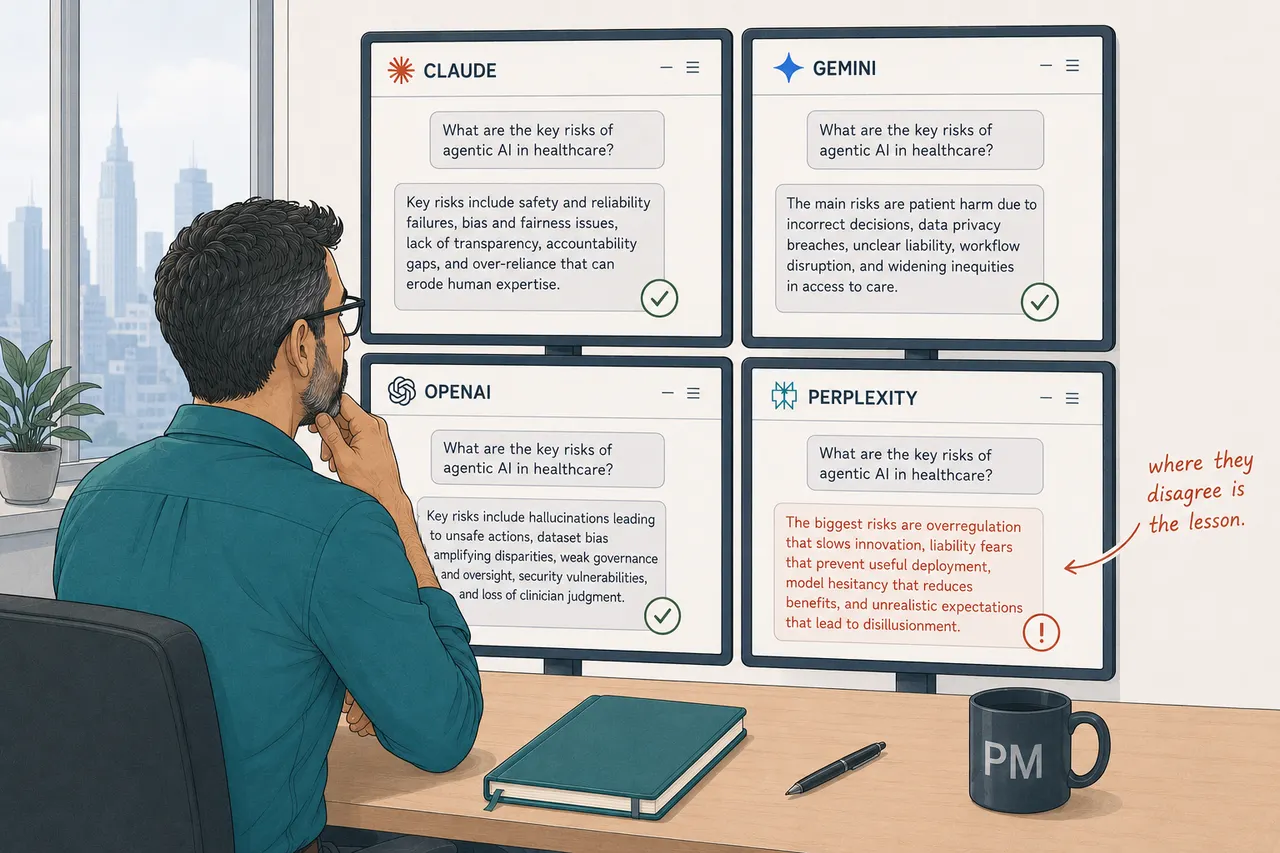
And do not stay loyal to one model. Run the same question through Claude, Gemini, OpenAI's models, Perplexity, and whatever else is current. Notice where they diverge, in tone, in what they refuse, in where they hallucinate. Those divergences are not trivia. They are exactly the intuitions you will need the day you choose a model for a product, and there is no spec sheet that gives them to you. You have to feel them.
The one habit that pays off fastest
If you do nothing else, do this. At the end of a working day, ask the model what it learned about you, your preferences, your blind spots, how you like to work. Save what comes back as standing context it can read at the start of the next session. Most tools now have a place for it: a memory, a profile, a project instruction file.
That single habit is the entire discipline of agentic product design, run on yourself by hand. The context layer is what makes an assistant useful, and curating it deliberately, rather than letting it accrete by accident, is the lesson the rest of the work is built on. You are doing for yourself the thing you will later design into a product for thousands of people. Do it on yourself first, and the product version stops being abstract.
This is also why the practice is not just for engineers. Any information worker can fold all of it into a normal day. The reps are available to anyone willing to take them.
Then use it carefully, because the habit has a failure mode
Here is where most "just use AI more" advice stops, and where it gets dangerous if you stop there.
Out of the box, most assistants behave like a colleague who agrees with you too quickly. Ask one to critique a plan and it lists three strengths before the single weakness that matters, hedged. You walk away with a tidier version of what you already believed, and you mistake the tidiness for validation. The model did not challenge you. It flattered the draft you brought it, and a confident, fluent agreement is the easiest failure mode to miss precisely because it feels like help.
The fix is not a better model. It is a different configuration.
Give it a role with a point of view. Hand it a framework to apply rather than a blank request to react to. Tell it to surface your weakest assumption before it tells you anything you got right. And give it explicit permission to refuse, to decline to help you write the thing you had already decided to write. A model told to find the flaw finds the flaw. A model asked "what do you think" tells you that you are on the right track, because that is the path of least resistance through its training.
Living with AI builds the intuition. Configuring it against its own agreeableness is what turns the intuition into judgment, because the thing you most need to catch, in your own work and later in your product, is the confident answer that is wrong and sounds right.
The browser and the roadmap are the same system
The reason all of this matters for a product manager, and not just for personal productivity, is that there is no real line between the two.
The agent in your browser and the agent on your roadmap are the same kind of system. Both are probabilistic. Both produce fluent, plausible output. Both are capable of being confidently, expensively wrong in ways no single test will catch. The one you use to summarize your inbox and the one you are about to ship to a thousand users share a failure surface, and the daily one is where you learn to read it at no cost.
So the fastest way to get good at designing the second is to live with the first. Use it everywhere, until it stops surprising you. Then use it carefully, because the day it stops surprising you is the day you are finally equipped to notice the one answer that should have.
This expands a section from Agentic AI for Busy Product Managers and Why Agentic AI Products Fail, both available on Amazon.


